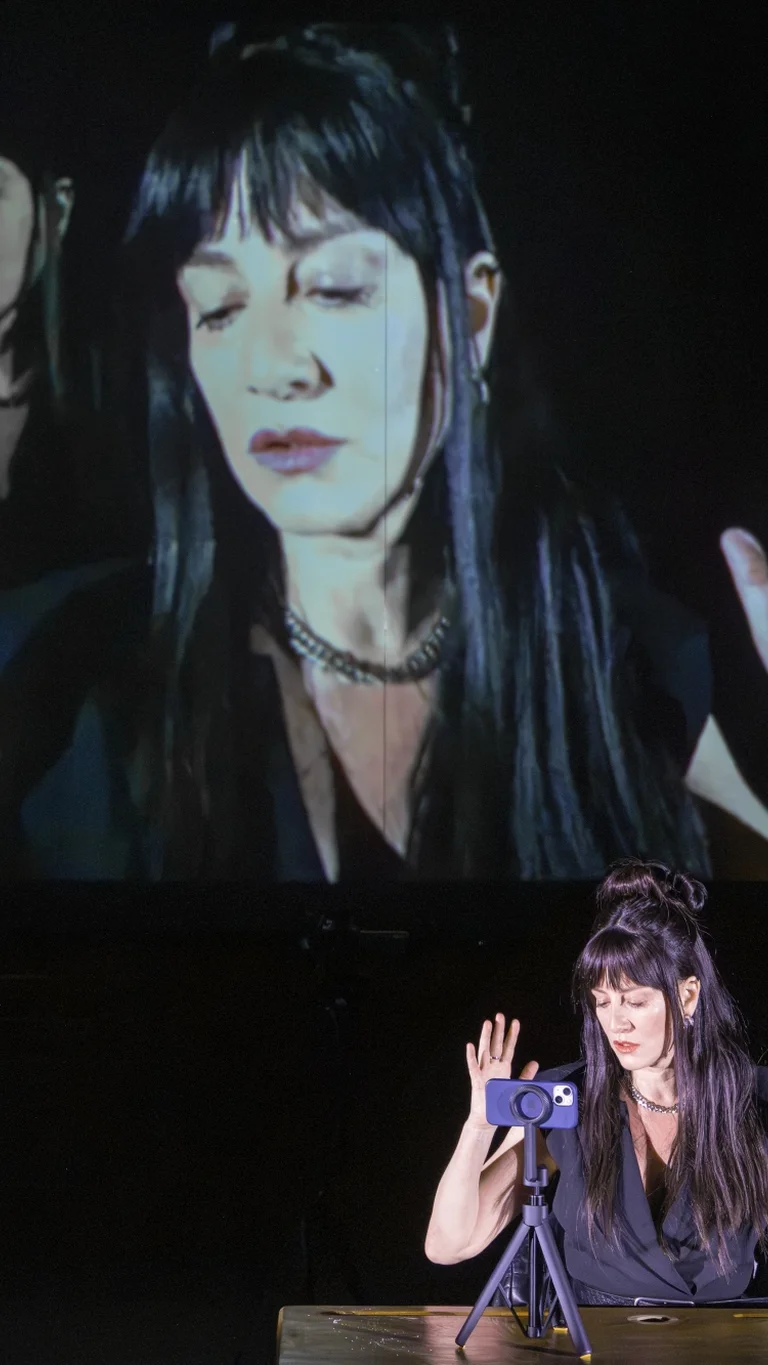
Europa – a parable of our time
Notes from Warsaw
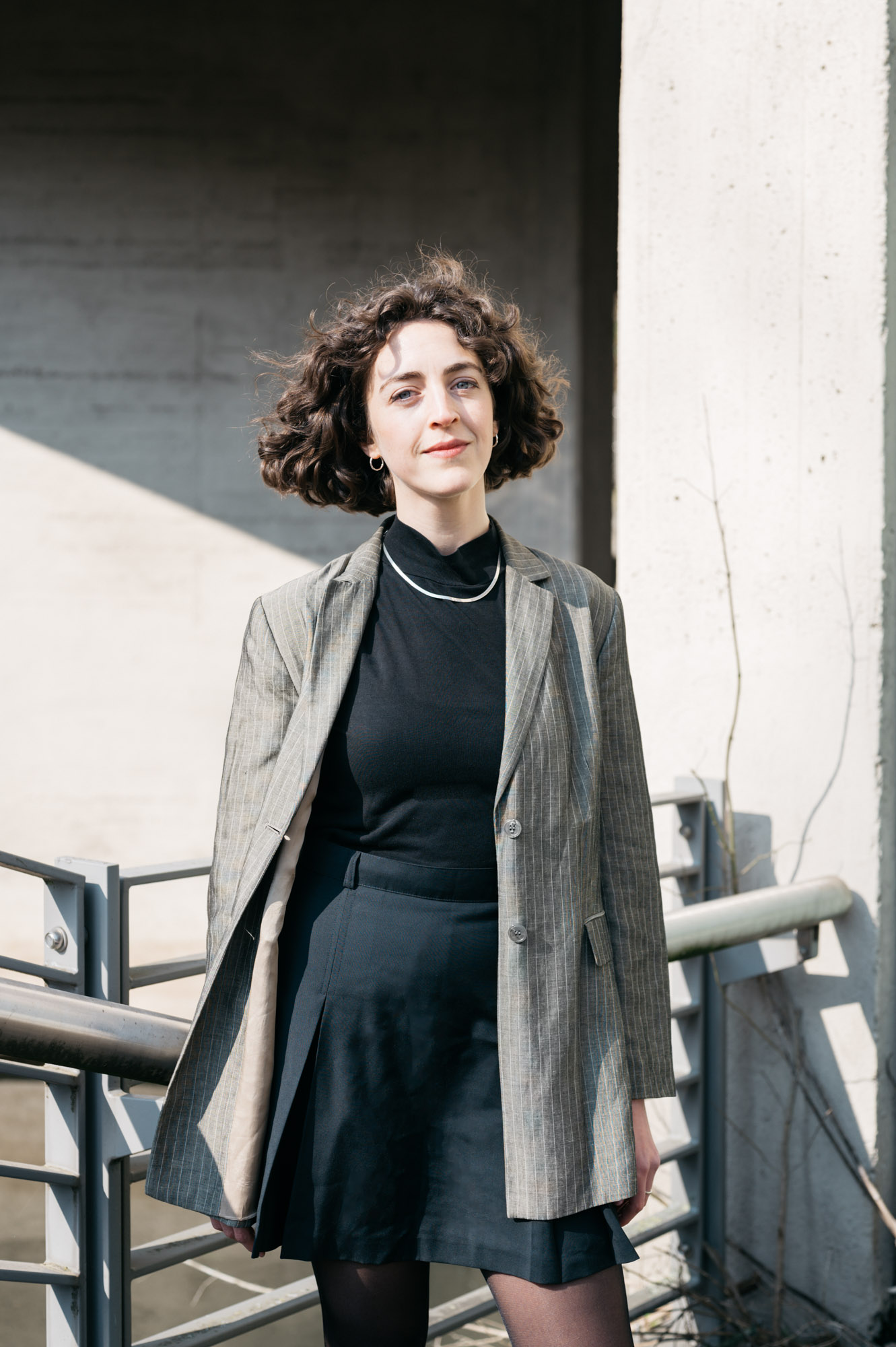
In February 2026, Ruhrtriennale dramaturg Teresa Bernauer travelled to Nowy Teatr in Warsaw to see Europa and speak with the artistic team.
When I arrive at Nowy Teatr an hour before the performance, the foyer is already full. People stand in small groups, speaking quietly; others gather at the bar, trying to get something to eat before Europa begins. The performances have been sold out for weeks. Whatever the mixed or even controversial responses may have been, they have not deterred audiences. If anything, they seem to have sharpened curiosity.
Before the performance, I meet the dramaturgs Carolin Losch and Piotr Gruszczyński. Slightly amused, they mention that the piece has been described as a “tragedy with the structure of a telenovela.” The phrase stays with me and begins to make more sense the longer I think about it: perhaps a familiar story in an accessible form yet unfolding according to a logic that refuses resolution.
We talk about the rehearsal process. The author of Europa, Wajdi Mouawad, they explain, usually does not allow changes to his texts for some time after they are written. Here, that was different. Due to the long-standing trust between him and the director Krzysztof Warlikowski, scenes could be shortened, others slightly reworked, and additional fragments incorporated drawn from Mouawad’s own writing, both theatrical and essayistic.
„Violence does not remain contained within the moment in which it occurs. It extends, often invisibly, into the lives that follow.“
I have to admit: I had never seen a work by Krzysztof Warlikowski live before. My expectations were shaped by what I had read and heard. With his piece Die Franzosen at Ruhrtriennale in 2015, he had already established, a certain sense of scale and ambition with my festival colleagues: large ensemble structures, extended duration, and a way of weaving literary material into complex, layered stage compositions.
A colleague once told me, half-jokingly, that a Warlikowski evening demands endurance. And given the themes of Europa: violence, inherited trauma, complicity, I expect a certain intensity. A work that accumulates rather than resolves, that demands attention rather than offering relief. At the centre of the story is a woman named Europa, who, in old age, attempts to speak about something long past – something that has shaped her life and, indirectly, the lives of her daughters.
My sense of the material is shaped largely by Wajdi Mouawad himself. In his writings and public conversations, he insists on the idea that violence does not remain contained within the moment in which it occurs. It extends, often invisibly, into the lives that follow – shaping relationships, decisions, and silences. What is transmitted is not only memory, but something more elusive: something that persists even when it is not named. Crucially, he shifts the perspective. The question is not only what has been done to us, but also what we have done to others. This shift complicates the familiar positions of victim and perpetrator and introduces a form of responsibility that does not end with the generation that acted.
„Theatre becomes a space in which this attempt is tested: how to approach what is difficult to endure without reducing or simplifying it.“
Language, in this context, becomes precarious. Mouawad returns to the attempt to replace violence with words – and to how fragile that attempt is. Theatre becomes a space in which this attempt is tested: how to approach what is difficult to endure without reducing or simplifying it.
What surprises me, then, is not the weight of the piece. It is there, unmistakably, but not in a stifling or settled way. The intensity remains in motion, carried by a group of performers who resist fixed identities. The female figures, in particular, remain open, shifting, refusing to be reduced to familiar narratives of femininity or psychological clarity. One figure – a young girl, something like a younger version of Europa – moves through the scenes without speaking. At one point, she writes on a chalkboard: a confession, or perhaps only its trace. She seems able to express, physically, what the adults hold back.
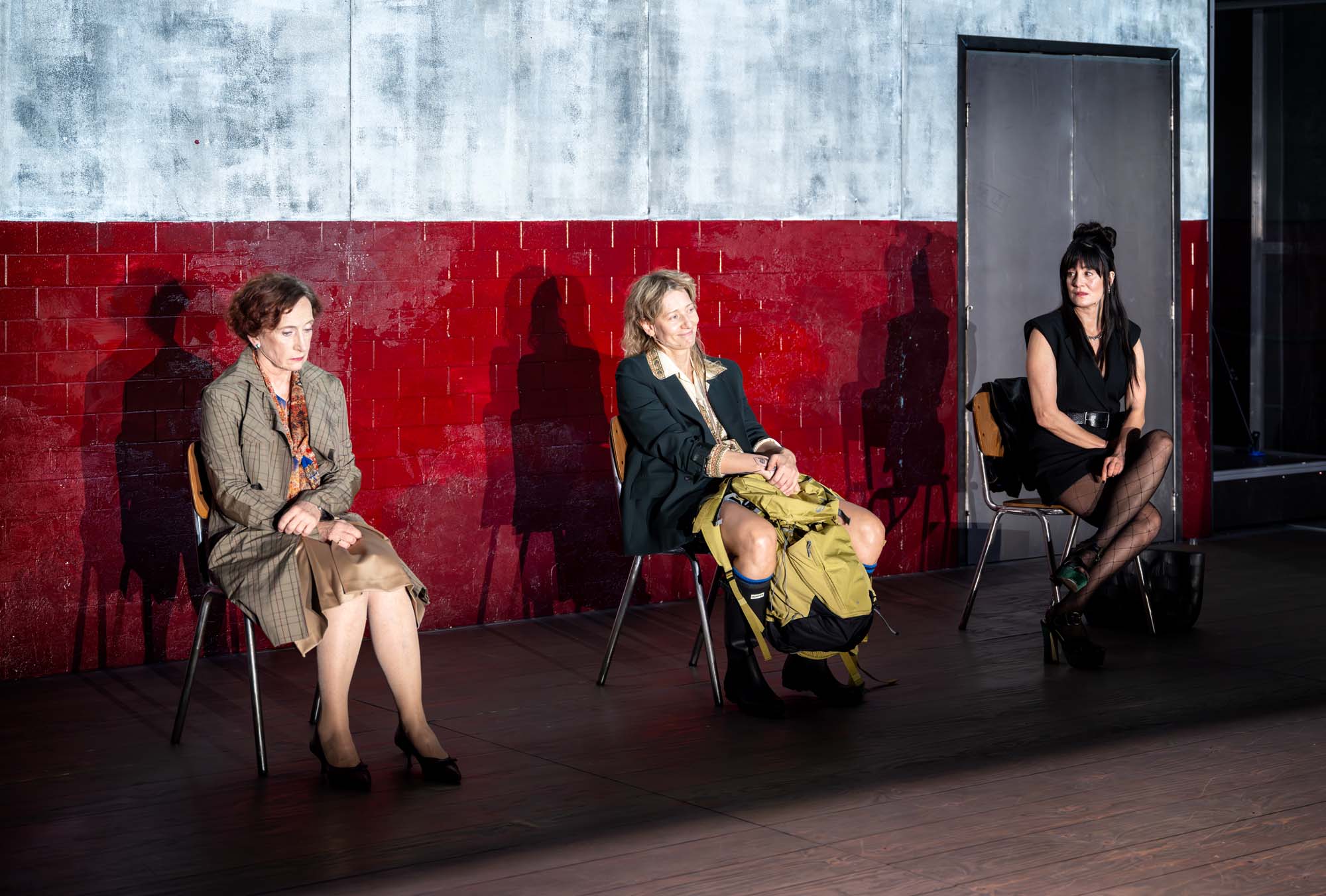
And yet there are moments of unexpected lightness, especially in the encounters between the three daughters. They come from entirely different contexts, have never met, and are now placed in a situation that demands some form of connection. Their resistance – the awkwardness, the misalignment – produces a kind of humour that can exist alongside the tragic circumstances.
After the performance, a certain speechlessness hangs in the air, along with the need to process what has been seen. Conversations begin slowly in the foyer. There is no quick consensus, no quick summary. Only now does the title begin to insist: Europa. What begins as a family story extends beyond that frame.
Europe: a continent marked not only by past violence, but by the difficulty of addressing it. By the ways in which histories remain unspoken, displaced, or only partially acknowledged. By the persistence of what has not been worked through. Is this a parable of our time? Not because it offers a clear lesson, but because it condenses a set of tensions that are widely felt: between past and present, between private experience and historical reality, between the desire to speak and the difficulty of doing so.
Mouawad has described how tragedy – as a shared framework for confronting such tensions – has largely disappeared from contemporary Europe, replaced by fragmented perspectives and isolated narratives. To return to tragedy, then, is not merely a formal choice It is a way of insisting that certain conflicts cannot be reduced to individual stories – that they exceed personal experience and require a space in which they can be confronted collectively, even if they cannot be resolved. Europa does not resolve them. But it creates the conditions in which they can – however briefly, however incompletely – be faced together.
About the author
Teresa Bernauer is a German-Portuguese dramaturge and curator. She is the theatre dramaturge at the Ruhrtriennale 2024–26. Previously, she worked at Künstler*innenhaus Mousonturm, co-founded the Nocturnal Unrest Festival, and coordinated the outreach project Places to See at MMK Frankfurt.