Dystopia in your shopping cart
Visiting the performance “Waste Me”
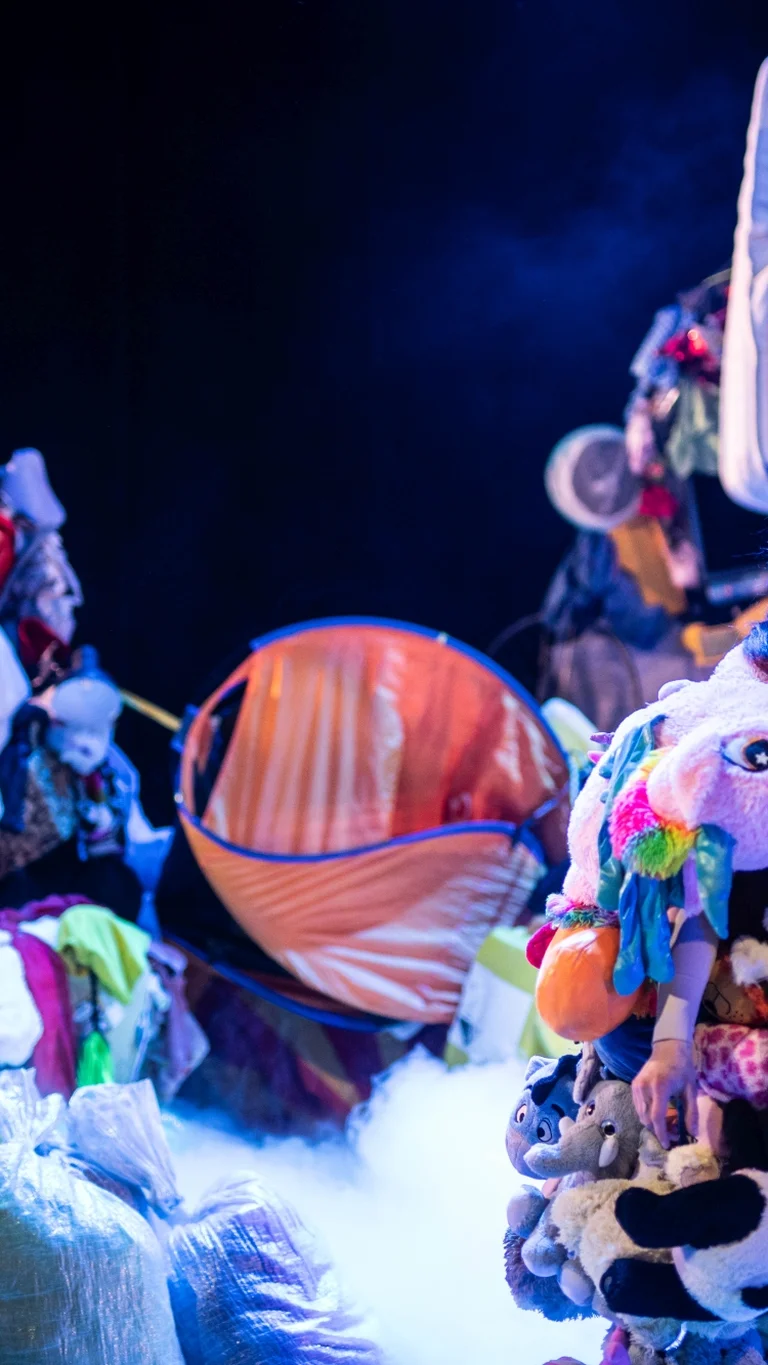
The sounds of the jungle intermingled with distorted birdcalls. A garbage dump from which household items protrude: a sofa, a washing machine. A sagging mattress. Clothes are strewn everywhere and a light mist wafts across the stage, as if this heap of throw-away items were breathing softly.
Strange creatures emerge from this seemingly lifeless jumble: a chair becomes a human, a body made of stuffed bin bags steps forward, soft toys form into a rolling creature. They all creep about. The rubbish heap crackles, rustles, moves almost imperceptibly – as if it has decided to no longer remain still. Somewhere between Jurassic Park and Stranger Things, I feel a slight unease, because this is somehow dystopian and yet, at the same time, not so far-fetched, I think.
„Somewhere between Jurassic Park and Stranger Things, I feel a slight unease, because this is somehow dystopian and yet, at the same time, not so far-fetched, I think.“
The five performers communicate with strange sounds; they seem to live in this mountain of rubbish, and their entire humanity has adapted to this place. Over the course of the next hour, I experience them as hoarders: they hoard objects, frantically and compulsively gathering clothes and things which they drag into their dens. A static flicker flickers across the television screens on stage.
People consume. Always and constantly, consciously and subconsciously. And in today’s digitalised world, it has never been easier to shop for a completely new wardrobe or furnish your home with a single click. After all, I am what I own! At least, that is what the advertising industry would have me believe. The performers in Waste Me start to tremble, to shake, their eyes shining with excitement as they dream of their next purchase, as they recall the feeling of tearing open the packaging of a new delivery! And so it is only natural that there is also a fashion show in this production: loud, colourful, enthusiastic. Pure ecstasy!
„After the ecstasy comes the sudden collapse. What was loud becomes quiet, what was colourful turns monochrome. Is this what overconsumption does to us?“
I find myself swaying along as the performers showcase the most famous fashion brands to the beat of drums and rhythmic singing. I hardly even notice that everyone is just revolving around themselves; it’s all about self-presentation, one’s own appearance, the latest look. I briefly wonder when I last placed an online order. Last week. Not too long ago.
After the ecstasy comes the sudden collapse. What was loud becomes quiet, what was colourful turns monochrome. Is this what overconsumption does to us? Suck the colour out of our souls? I watch as the performers, utterly exhausted, try to connect with one another. But there is no strength left for that. Everything is suddenly so alienated, empty. Waste Me. Throw me away!
At the end, they stand at the edge of the stage and sing. The lights go out and the feeling I had at the start returns: that slight unease, because this performance was somehow dystopian and yet not so far removed. I think again about my online order and how I’ll feel when I open the parcel. The anticipation is still there, but a question has crept in: Do I really need what I’ve ordered? A distorted birdcall echoes in my head.
About the author
Britta Schünemann is the Ruhrtriennale's head dramaturge and responsible for mediating the Junge Triennale projects. After completing a Master's degree in Music and Latin at the University of Osnabrück, she undertook stage management training at the Berlin State Opera, specialising in the scenic interpretation of music theatre. She then completed a two-year university course in music theatre education at the Mozarteum in Salzburg. She then held positions at the Nuremberg State Theatre and the Stuttgart Young Opera, followed by a teaching position. From 2017 to 2022, she developed educational programmes for young people in her role as a music theatre educator at Musiktheater im Revier in Gelsenkirchen.