The Art of Walking Through Walls
We’re not exaggerating when we describe Marina Abramović as one of the most significant contemporary artists there is. Performances like Rhythm 0 and The Artist Is Present have made the Serbian artist world-famous well beyond the boundaries of the art world. She has spent decades of her life making art and of course there’s no end in sight, because for her, life and artistic creativity are inseparable. It’s virtually impossible to sum up Marina Abramović’s life in just a few points. We’ve done it anyway and chosen ten exceptional stages of her life in an attempt to get closer to this extraordinary artist.
Growing up with discipline, violence and spirituality
On the 30th of November 1946, there was absolutely no indication that decades later Marina Abramović – daughter of two national heroes in communist Yugoslavia, under the leadership of Josip Broz Tito – would become one of the greatest artists of our time. Abramović herself describes her childhood as marked by discipline, harshness and violence, especially from her mother Danica. She finds refuge with her grandmother, with whom she spent the first few years of her life, a devout, spiritual woman, who interpreted dreams and found meaning in coffee grounds. Both aspects of her upbringing influenced Abramović’s character and art throughout her life.
From painting to performance art
One thing she shares with her mother Danica is her love of art. Marina Abramović starts painting at a young age, then meets the Serbian artist Filo Filipović at 14, with whom she takes her first painting class. A deeply formative encounter, which Abramović describes as follows: “He cut out a piece of canvas and put it on the floor. He opened a can of glue and threw the liquid on the canvas; he added a little bit of sand, some yellow pigment, some red pigment, and some black. Then he poured about half a liter of gasoline on it, lit a match, and everything exploded.” “This is a sunset,” he told me. And then he left.” (1) All that was left was ash. Abramović comes to realise: the process is more important than the result.
In search of boundless freedom
After several performances with the student movement “Group 70”, Marina Abramović first comes to the attention of a wider international audience in 1973 in Edinburgh, Scotland. Rhythm 10 is based on a drinking game played in rural Russia and Yugoslavia. The rules are simple: one person places their hand on a wooden table with their fingers spread and quickly stabs a knife into the gaps. Every time the person cuts themselves, they have to take a drink. The more they injure themselves, they more they drink, and the more they injure themselves. Abramović performs several rounds of the ritual, records the sound, then performs it again synchronised with the previously recorded audio track. With this performance, she realises: “Once you step in the performance space, […] it’s not you anymore. It’s something else.” (2) A feeling of absolute freedom, without any boundaries, one that Marina Abramović will continuously seek out from this point on.
The connection between the artist and the audience
As a result of the public attention, Abramović is increasingly criticised for her performances, especially in her home city of Belgrade. The accusation: her performances were not art, they were merely the work of an exhibitionist and masochist. Her reaction: do nothing. In Rhythm 0, all the actions are decided by the audience. Over a period of six hours, the audience can choose from 72 objects lying on a table, including a newspaper, a feather and a polaroid camera; right beside them needles, knives, a saw and a pistol loaded as well as a bullet. Abramović remains motionless, lets the audience do whatever they like to her. This performance shows the intense relationship between Abramović as a performance artist and the audience: she allows them to see into her deepest inner self. In Rhythm 0, she frees herself from her fear of pain, of death, and thus functions as a mirror for the audience. What follows is catharsis: “If I could do it, they could do it, too.” (3)
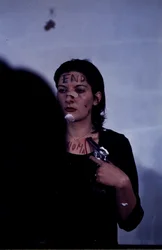
Marina Abramović: Rhythm 0, Performance, 6 hours, Studio Morra, Naples, 1974 © Courtesy of the Marina Abramović Archive 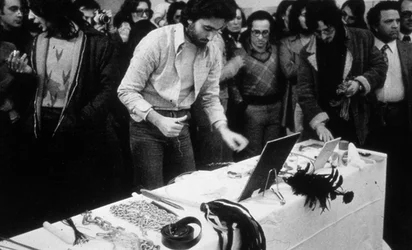
Marina Abramović: Rhythm 0, Performance, 6 hours, Studio Morra, Naples, 1974 © Courtesy of the Marina Abramović Archive
Ulay
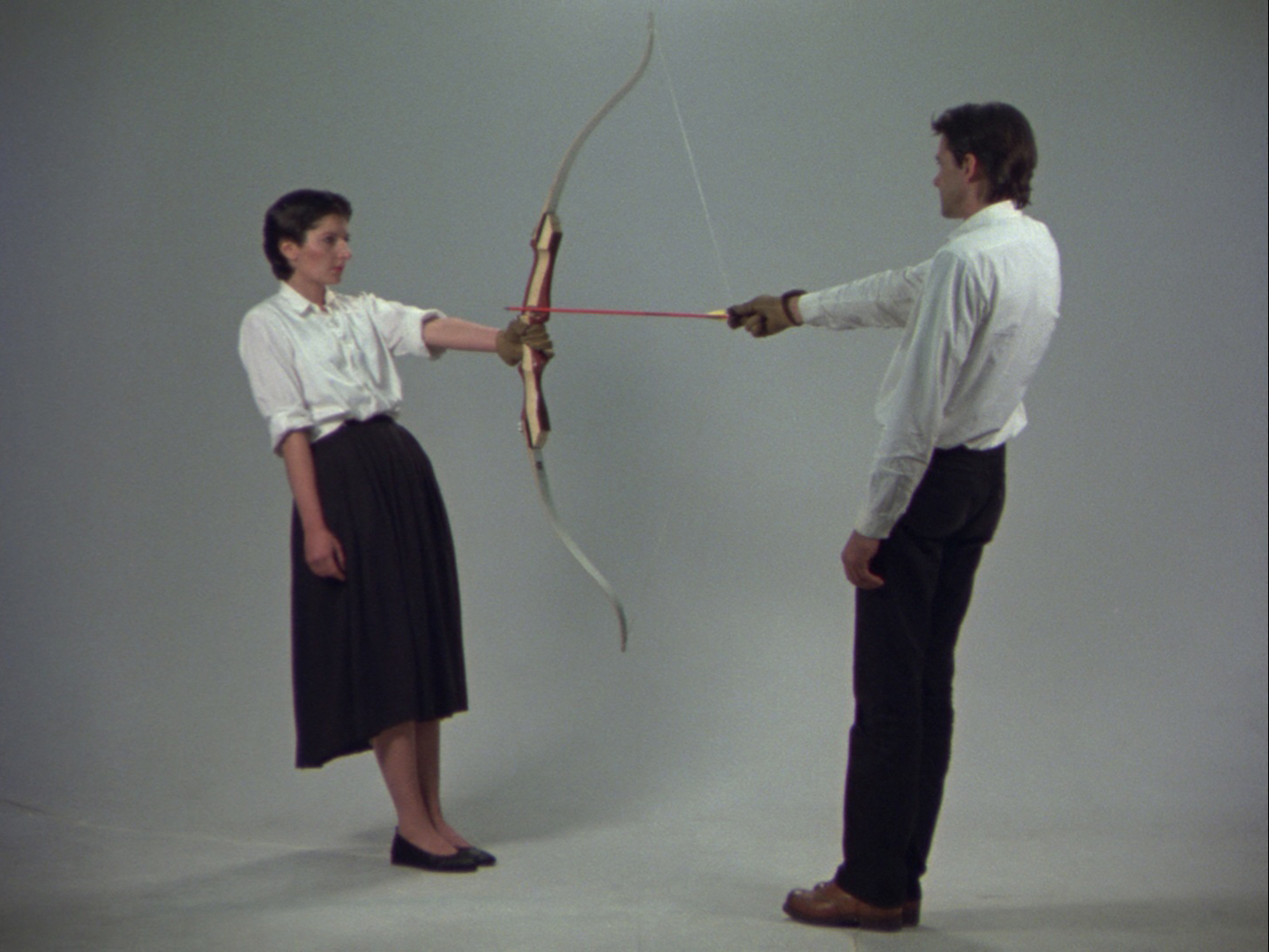
Between 1976 and 1988, Abramović produces a large number of pieces in collaboration with her partner Ulay, with whom she spends twelve years living a nomadic life. In these pieces they deal with their own relationship in sometimes extreme performances that address themes such as love, trust, conflict and vulnerability. Probably the most well-known performance, which Abramović called “the ultimate portrait of trust”, is Rest Energy (1980). In it, Abramović holds a bow, while Ulay pulls back the bowstring with the arrow aimed at her heart.
In 1982, Abramović and Ulay announce a new, one of a kind collaboration: in The Lovers each of them will start walking from one end of the Great Wall of China, meet in the middle and get married. It was not until 1988 – after tough negotiations with the Chinese government – that they finally managed to carry out the difficult march across partly inaccessible terrain. After 90 days and having walked a distance of 2,000 km each, the two of them met in the middle of a bridge in Shenmu. What followed was not the long-awaited wedding, but a farewell, and with that the end of their collaboration and relationship.

Will power, determination and endurance
Many of Abramović’s performances are considered “durational performances”, challenging her own limits of will power, determination and endurance time and time again. In the Australian desert, after months of living with the Aborigines in the years 1980/1981, Abramović attained a previously unknown mental state that allows non-verbal communication. The experiences of not moving, not eating and not speaking become the foundation of Gold Found By The Artists (later Nightsea Crossing): for 16 days, the artist sits opposite her former partner Ulay for eight hours a day, always with the question in the back of her mind: Will we reach a new state of consciousness? Might it be possible to communicate telepathically? She performs the work to the end despite all the physical pain and mental challenges. Between 1981-1987, they perform the piece Nightsea Crossing 22 times in 19 locations across the world.
Golden Lion in Venice for “Balkan Baroque”
On the invitation of Petar Cuković, director of the national Museum of Montenegro, Marina Abramović is to represent Serbia and Montenegro at the 1997 Venice Biennale. Balkan Baroque is her reaction to the Balkan Wars and also stands for all the wars fought throughout the world. For four days, she cleans thousands of bloody beef bones, a reference to the ethnic cleansing that took place in the 1990s in the Balkan countries. Her blood-stained hands are proof that war crimes cannot be washed clean of their guilt. The announcement ends in scandal: Montenegro’s Minister for Culture Goran Rakocevic vilifies Abramović, who then withdraws her participation in protest. Instead, she performs Balkan Baroque – invited by Germano Celant, Curator of the Venice Biennale – in the basement of the international pavilion in Giardini and wins the Golden Lion for best artist.
Star status with “The Artist Is Present”
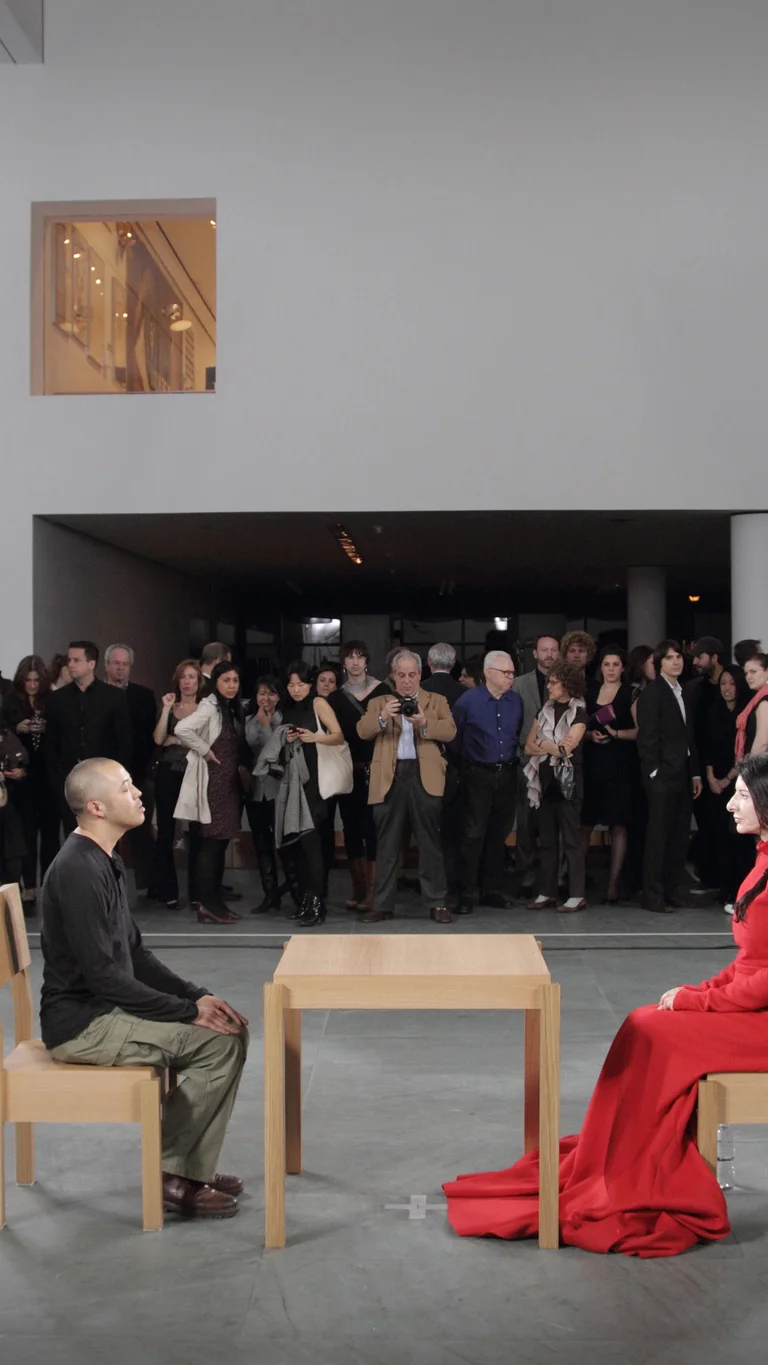
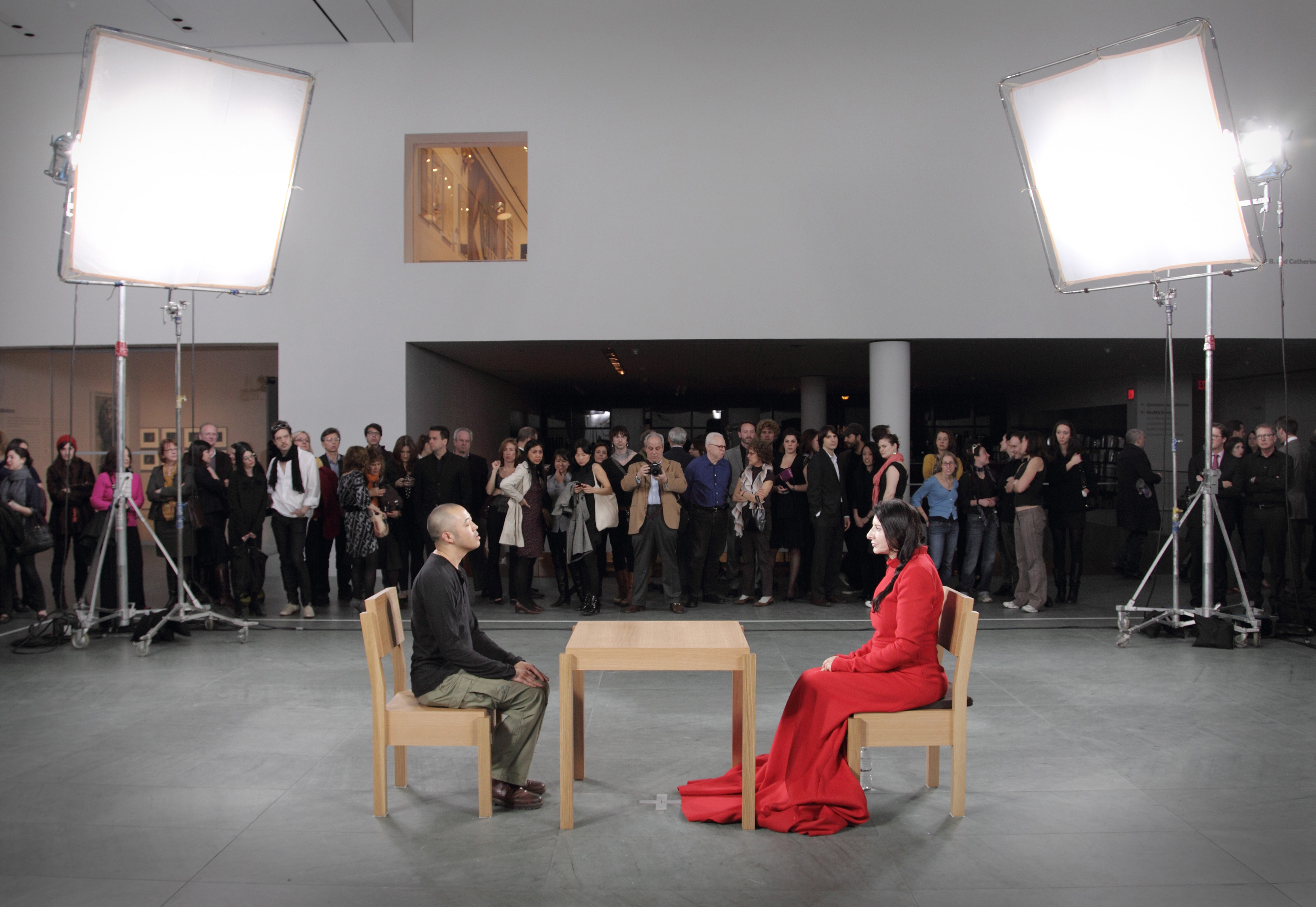
With The Artist Is Present, Abramović once again proved that all obstacles, whether physical or mental, can be overcome. As part of a retrospective spanning decades of her work at the Museum of Modern Art (MoMA) in New York, she performs what is probably her most famous piece. In The Artist is Present (2010), Abramović sits motionless on a chair, just like in Gold Found By Artists / Nightsea Crossing. While in those performances Abramović sat opposite her former partner Ulay for sixteen days for eight hours a day, she now undertook to sit for three months, for eight to ten hours a day. This time, however, it was the audience that completed the performance and was to take the empty seat opposite Abramović. After 736.5 hours and more than 750,000 visitors, of which 1,500 people took a seat in the chair, the performance ended on the 31st of May 2010. Marina Abramović had ascended Mount Olympus of the art world and liberated performance art from its niche existence.
The Abramović Method
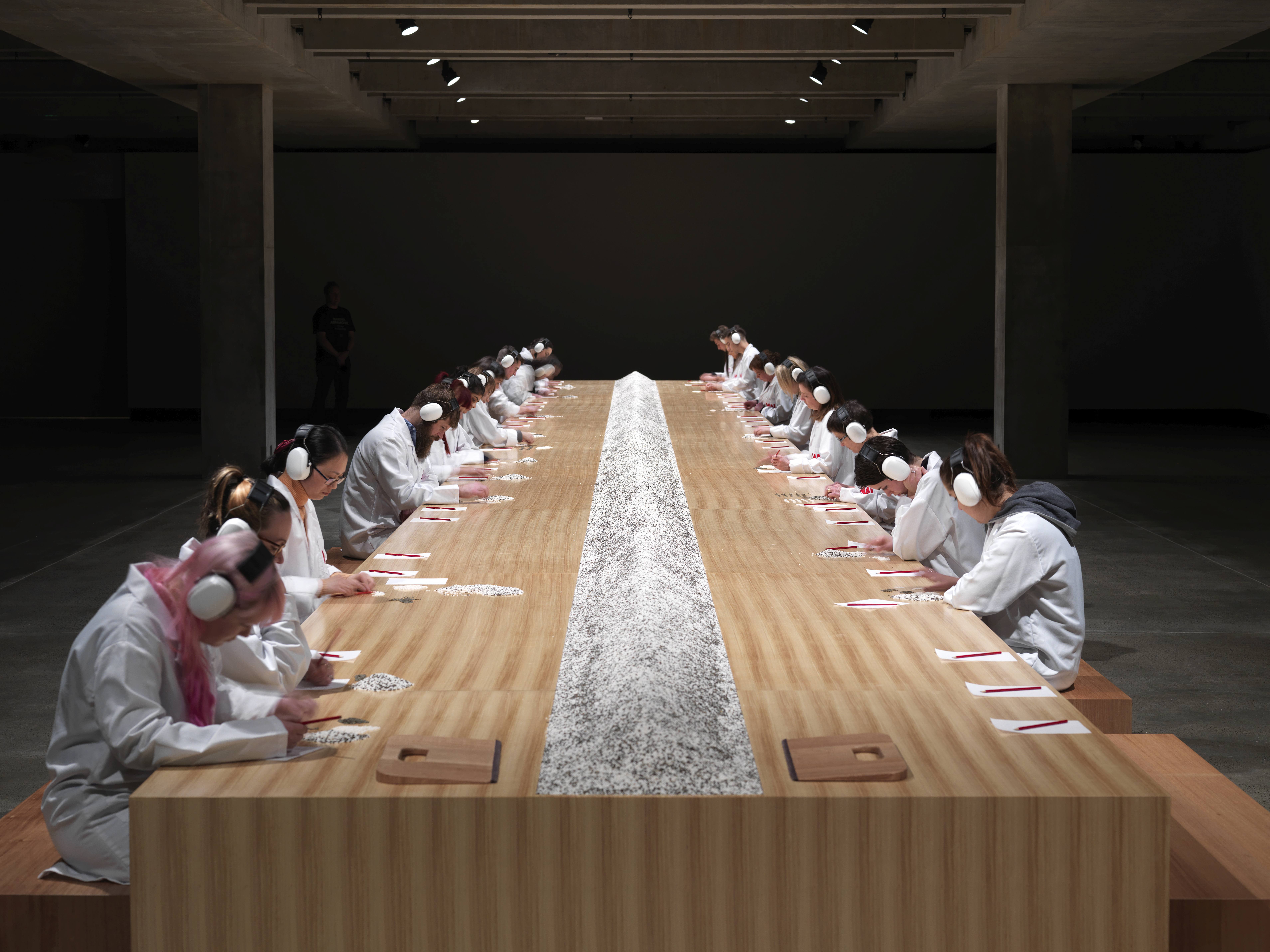
Over the course of her life, Marina Abramović sought out places of spirituality again and again, often staying for months at a time, places fundamentally opposed to our modern world of permanent availability, constant distraction and continuous sensory overload, including Bodhgaya, the place where the Buddha attained enlightenment, the Tushita monastery in the hills of the Himalayas and the Great Victoria Desert in Australia. The artist then translated the experiences she had in these places into a series of practices and exercises that she calls the “Abramović Method”. Quiet, repetitive processes, without external stimuli and distractions, enable a connection to ourselves, to others, and allow us to live in the present moment again. The method reached its first peak in the exhibition 512 Hours, which allowed visitors to see and experience the transformative power of performance art for themselves. For Marina Abramović, this exhibition marks a turning point: “I […] understood that this was the time to transfer my own experience to everyones else.” (4)
The Life and Death of Marina Abramović
Death plays a constant role Abramović’s performances, who completely rejects the idea of “eternal life”. Instead, she regards the idea of integrating death into one’s life as fundamentally important. It is therefore no surprise that Abramović conceives of her own death as her final work of art, nor that she has planned her own funeral down to the very last detail: “I want to have three Marinas. Of course, one is real and two fake because you can’t have three bodies. But I want these three Marinas buried in the three cities which I’ve lived [in] the longest, which is Belgrade, Amsterdam and New York.” (5) The song selection for the funeral almost goes without saying: My Way – in the version by Nina Simone, sung by Anohni.
(1) – (4) Marina Abramović: Walking Through Walls