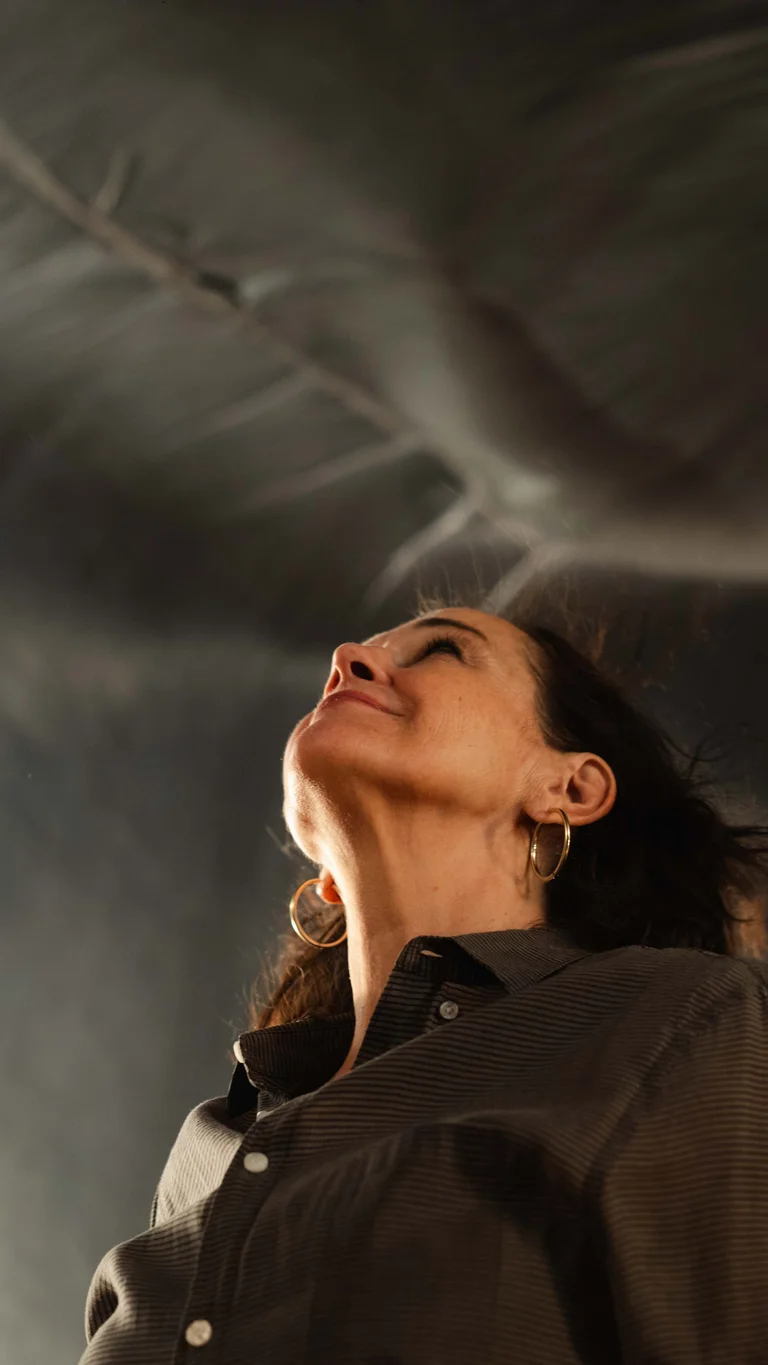
“In theatre, I look for nourishing solace, not cheap comfort”
Ruhrtriennale dramaturg Teresa Bernauer in conversation with Christopher Rüping
How can we come to terms with a present in which the ground beneath our feet has become unstable? Director Christopher Rüping and dramaturg Teresa Bernauer discuss Stig Dagerman, dizziness and German history – and why theatre can be a place of comfort.
Teresa Bernauer: For many people – at least for a certain generation – the title German Autumn immediately brings to mind the year 1977. Your piece, however, begins at a different starting point: with a daughter, her father, a dizziness that won’t go away and, of course, Stig Dagerman’s German Autumn of 1946. What made you want to give new meaning to this title in the present day?
Christopher Rüping: As you already mentioned, there are various kinds of German autumns. At first, one might think of the episode film Germany in Autumn and the “German Autumn” as the era of the RAF, the Red Army Faction. But if you look at history, there are many German autumns – far more autumns, in fact, than German springs or summers. What does that say about our culture? On the one hand, autumn is the season of abundance – of harvest, wine and song – and on the other, it is a time of death, of letting go and of preparing for winter. That makes it an incredibly evocative title for phases of history. And, of course, autumn as a season is cyclical. It returns again and again. It seems to be exactly the same in German history: the German autumn returns at regular intervals. For me, therefore, the “autumn” referred to in the title is the autumn of 2026, the autumn in which we will have our premiere and in which many questions from past autumns will arise once more.
TB: Which questions from Dagerman’s text strike you as particularly pressing for today?
CR: The autumn of 1946 that Stig Dagerman describes took place exactly eighty years ago, which is roughly a human lifetime. I’m interested in the question of whether it’s a coincidence that we’ve arrived at such an autumn again at this particular point in time. Could it perhaps have something to do with the fact that all the people Dagerman encountered back then are now falling silent? Just as our protagonist’s father has fallen silent? For me, that is the conceptual link between these two autumns. Dagerman also travels through Germany on a mission to find out whether the people he meets are Nazis at heart or whether they were co-opted by a fascist regime. It’s a question that Hannah Arendt and many other thinkers were grappling with at the time as well. Dagerman comes to a surprisingly simple conclusion: if you ask someone who is starving on two slices of bread a day whether they were better off when they had five slices of bread, they will of course say yes. For us as Germans, this is a challenging perspective, because we are accustomed to viewing this generation from a critical distance. Dagerman, on the other hand, travels through the country as a Swede, neither as a direct victim nor as a direct perpetrator. He looks at the people he encounters with an unbiased eye.
TB: Fear is a motif that runs through the entire evening – the fear of the post-war period as well as the fear of losing one’s memory, political fears, but also very physical experiences such as dementia or panic attacks. What interests you about fear as a social force?
CR: Our production doesn’t actually begin with fear, but with dizziness. A woman in her forties feels dizzy. No one can find a medical cause. At some point, she stops searching as a patient and begins to search as an artist: in conversation with her father, with herself, inside her inner ear. It takes a while before she begins to understand the physical dizziness as a manifestation of fear. There are studies suggesting that around eighty per cent of people with symptoms of dizziness are actually suffering from an anxiety disorder. Dizziness always has to do with a loss of bearings: with unstable ground, with a loss of control, with the feeling of no longer being able to distinguish between up and down. The subject begins to dissolve. And I think this crisis of identity is a very apt diagnosis of the twenty-first century. That is why, for me, dizziness is more than a private phenomenon. It is a social phenomenon. There are artists exploring the same territory as we are: the project Iliggocene – The Age of Dizziness, Camille de Toledo with his book Une histoire du vertige. They are all attempts to understand our present through the image of dizziness. I really do believe that dizziness is something that connects us. When I listen to myself, to my friends, to the people I work with – including actors I have been making theatre with for years – I encounter dizziness much more frequently in the autumn of 2026 than I did at earlier stages of my life. And behind the dizziness lies fear.
„Theatre is community on a trial basis. That is why it makes sense to me, particularly now, to explore this dizziness in theatre – a dizziness that has so much to do with fear, uncertainty and loneliness.“
TB: In the piece, dizziness appears, on the one hand, as a loss of orientation, but also as a moment of opening up or transformation. What about this dual movement appeals to you?
CR: Camille de Toledo describes this beautifully: dizziness is always dizziness. But there are states of dizziness that we actively seek – through intoxication, drugs, alcohol, sex, art. And then there is the other kind of dizziness: the kind in which you fall and break your bones. Camille de Toledo says that, in fact, these two kinds of vertigo are indistinguishable from one another. There is only one form of vertigo. Sometimes we can enjoy the dizziness and the loss of control that comes with it; sometimes it frightens us. When it frightens us, we try to regain the control we are just beginning to lose as quickly as possible. Then we fall back on concepts such as nation, homeland or gender roles – on anything that promises us stability in a time that offers none. Camille de Toledo advocates a different way of dealing with this dizziness: the possibility of understanding the dissolution of fixed identities not as a threat, but as potential. He leaves open what that might look like in concrete terms. That is precisely the question that also interests the Iliggocene project: how can dizziness become an opportunity? One simple answer is community. The less I am preoccupied, in the moment of disorientation, with asking myself who I am, and the more I open myself up to other people in my state of vulnerability and form a sense of community, the less threatening this disorientation becomes. This brings us close to theatre and the fleeting communities that can emerge in the course of a performance.
TB: At a time when many people feel that certainties are falling away, what role can theatre play?
CR: I think art can examine phenomena of our time that we experience in our own bodies and, within a fictional framework, transform them into potential. Our production isn’t an essay about dizziness; it is very concretely connected to the performers and their experiences. As I see the piece at the moment – and we are, of course, still right in the middle of the process – you watch a person who is dizzy and therefore tries to hold on gradually let go of that need to hold on. She accepts the risk of disorientation, of uncertainty about herself. And in return she is rewarded with a fleeting form of community – with the people she is playing with and with those who are watching. I’m interested in the possibility of becoming dizzy together. Theatre can do that. Every performance contains the possibility of a temporary community that exists for the duration of the evening and perhaps resonates for a few hours afterwards. Theatre is community on a trial basis. That is why it makes sense to me, particularly now, to explore this dizziness in theatre – a dizziness that has so much to do with fear, uncertainty and loneliness.
„I hope that there is something about the evening at the theatre that will deliver me from this catastrophe once more. That offers comfort.“
TB: A distinctive feature of the evening is how family history, personal experience and German history constantly intertwine. How do private memory and social history relate to one another for you?
CR: I’m no expert on this, but I would argue that individual and collective experiences can never be entirely separated from one another. In that sense, history plays a major role in our evening, but we’re not staging a historical or academic event. It’s about personally experienced, fragmented, remembered history – history that has settled in one’s own inner ear. I think at school we are often encouraged to learn to regard history as something separate from ourselves. In essence, the protagonist in the play says that, of course, she is familiar with black-and-white photographs from the era into which her father was born. But she has never associated the reality of those photographs with him. When I go to rehearsals here in Berlin, I walk past building façades every day where bullet holes are still visible. I actually only know the period Dagerman writes about from history books. And yet it has left scars in this city to this day – and in the people I grew up with. So it doesn’t just exist in archives and books. It is physically embedded within us and influences the way we live, think and feel. And that is perhaps why it makes sense to listen inwardly, to follow our own dizziness and fears and, in doing so, to look back beyond our own birth. The experiences of our parents and grandparents shaped them, shaped our relationships with them – and in that way have shaped us too.
TB: Does looking at history in this way also change our responsibility towards it?
CR: Yes. At the very least, it means understanding ourselves as part of history rather than as something that stands outside it. I think it’s important that objective historical research exists. There needs to be an attempt to remove subjectivity from history. But theatre isn’t the right place for that. For me, theatre is always a place of subjectivity, of the personal, of the fragmentary. It is never about completeness, but always about a particular perspective on history.
TB: The evening repeatedly circles around memories and their disappearance – dementia, the generation of contemporary witnesses, historical experiences that are increasingly only recounted rather than personally remembered. Is forgetting primarily a loss for you, or can there also be something liberating about it?
CR: That’s an interesting question. There are different forms of forgetting. Forgetting can also mean freedom. Just think of the discussion about whether the internet should eventually be able to forget – because, unlike our memory, it has no shelf life. The kind of forgetting we are dealing with in our piece, however, feels like a loss to me. Information has disappeared that might help us decipher our symptoms, our fears and our dizziness. It has probably vanished from active memory, but not from bodily memory – or from the body of cultural memory, if such a thing exists. For me, that is a problematic kind of forgetting. More generally, though, I would say that there are moments when forgetting can also be a relief.
TB: The evening deals with loss, illness, transience and historical catastrophes – but also with warmth, humour, music and care. What role does comfort or solace play in your work?
CR: I think that’s very subjective and probably subject to change at different stages of life. But when I go to the theatre, I’m often looking for solace. There are, after all, hardly any plays in which everything goes well from start to finish. More often than not, some form of catastrophe unfolds. And we voluntarily sit down in a space – in our case, the Jahrhunderthalle – and, together, surrender ourselves to this catastrophe for a few hours. I don’t know if I’m alone in this, but I don’t do it because I want to enjoy the catastrophe. Rather, I hope that there is something about the evening at the theatre that will deliver me from this catastrophe once more. That offers comfort. Especially at a time like this, which I often experience as bleak, that has become even more important to me. And for me, this evening – quite apart from the fact that Dagerman’s Trost, his comfort, is a text that deals quite explicitly with this question – is full of various forms of comfort. Comfort in community. Comfort in the dialogue between the generations, which, whilst it no longer functions between Wiebke and her father, does take place elsewhere with Almut Zilcher. Comfort in play, in being playful, and even in being silly. And comfort in intoxication, when the dizziness suddenly feels like a high rather than an involuntary loss of control. In theatre, I look for nourishing solace, not cheap comfort. Solace as a form of comfort that has been earned. That is why, from my perspective, this evening is never only heavy. When it is announced, one might expect a heavy, depressing evening of history. But that is only part of it. It is also bright, tender, quiet and playful. Autumn itself is, after all, both: a time of dying and thus also of mourning – but at the same time a time of abundance, of wine, of singing and of being together. Our evening moves between these two poles.
TB: Here you are working both with long-standing collaborators such as Wiebke and Benjamin and with actors you are working with for the first time. What emerges from that combination?
CR: I’m very grateful to every single person in this ensemble, because they each have a completely individual perspective on this world and their own way of relating to it. I’ve worked with Wiebke, Benjamin and Steven for many years. I used to work a lot with Svenja, and now we’re meeting again after quite some time. Komi and Almut are joining us for the first time. For me, that creates a good mixture. The great familiarity between us gives us the confidence to approach painful subjects such as dementia, dizziness or loneliness very quickly. But if you only work with people you know extremely well, it can easily become something of a closed shop. You already understand one another and question yourselves less. That’s why I’m very grateful to Komi, Almut and also Svenja. New voices constantly force you to distinguish between what you genuinely believe and what has simply become habit or taste. At its best, an ensemble like this creates a balance between familiarity and new perspectives. And that is exactly how this rehearsal process has felt to me.
TB: The piece is also being created for the Jahrhunderthalle. How do you approach a space like the Jahrhunderthalle?
CR: Basically, I feel quite at home in spaces like this. When I first started directing, I worked a lot in industrial halls – at Kampnagel in Hamburg, for example. That is obviously different from the Jahrhunderthalle, but these are still spaces that were originally used for industrial purposes and later became cultural venues. So I don’t enter the Jahrhunderthalle thinking, “Oh God, how am I supposed to direct something in here?” Quite the opposite. I like spaces with a strong character of their own. Many proscenium theatres pretend to be a blank canvas that can be filled however you like. The Jahrhunderthalle doesn’t do that. It always remains the Jahrhunderthalle, no matter what you build inside it. And that is precisely what interests me. My theatre benefits from real spaces showing through the piece. In the same way, the personalities of the actors always show through the characters they play. It creates a kind of double exposure. With German Autumn, there is another layer. When we talk about 1946, the Jahrhunderthalle was already standing. Stig Dagerman could have seen this space. There is a scene in which Steven films the architecture of the hall while simultaneously talking about the ruined landscapes of the Ruhr region in 1946. Those are exactly the kinds of moments that interest me. The space becomes part of the storytelling. Different periods of time encounter one another in a place that itself carries history within it. I’m very much looking forward to that tension.
TB: Finally, one last question: the evening repeatedly asks what remains when memory disappears. After all these months of research and rehearsals – what do you think remains?
CR: Of what?
TB: Of the evening.
CR: Nothing. And perhaps that is precisely the beauty of theatre. By the time everyone who has seen or created this evening has died or been forgotten, nothing of it will remain. Photographs tell us nothing about a night at the theatre. Even a video recording cannot capture it. Theatre can only be experienced. It is perhaps the most ephemeral of all art forms – and precisely for that reason, so close to life. There is a moment in the piece when Caspar David Friedrich looks at the way his paintings were appropriated by National Socialism. I imagine it must be difficult to witness what later generations do with your own work. Theatre disappears. And for me, there is a certain comfort in that too. At the moment, though, I’m not really thinking about the performances yet. I’m thinking about this group of people we’re working with – the actors, the artistic team, the assistants, the interns. I still hope that something remains for us: a connection with something that preoccupies us. That comfort can be found. That a sense of community is fostered. And that is exactly what I wish for the audience too. Theatre may not be eternal. But I believe it can leave its mark on the people who encounter it.
The interview was conducted by Teresa Bernauer from the Ruhrtriennale’s dramaturgy team on 24 June 2026.