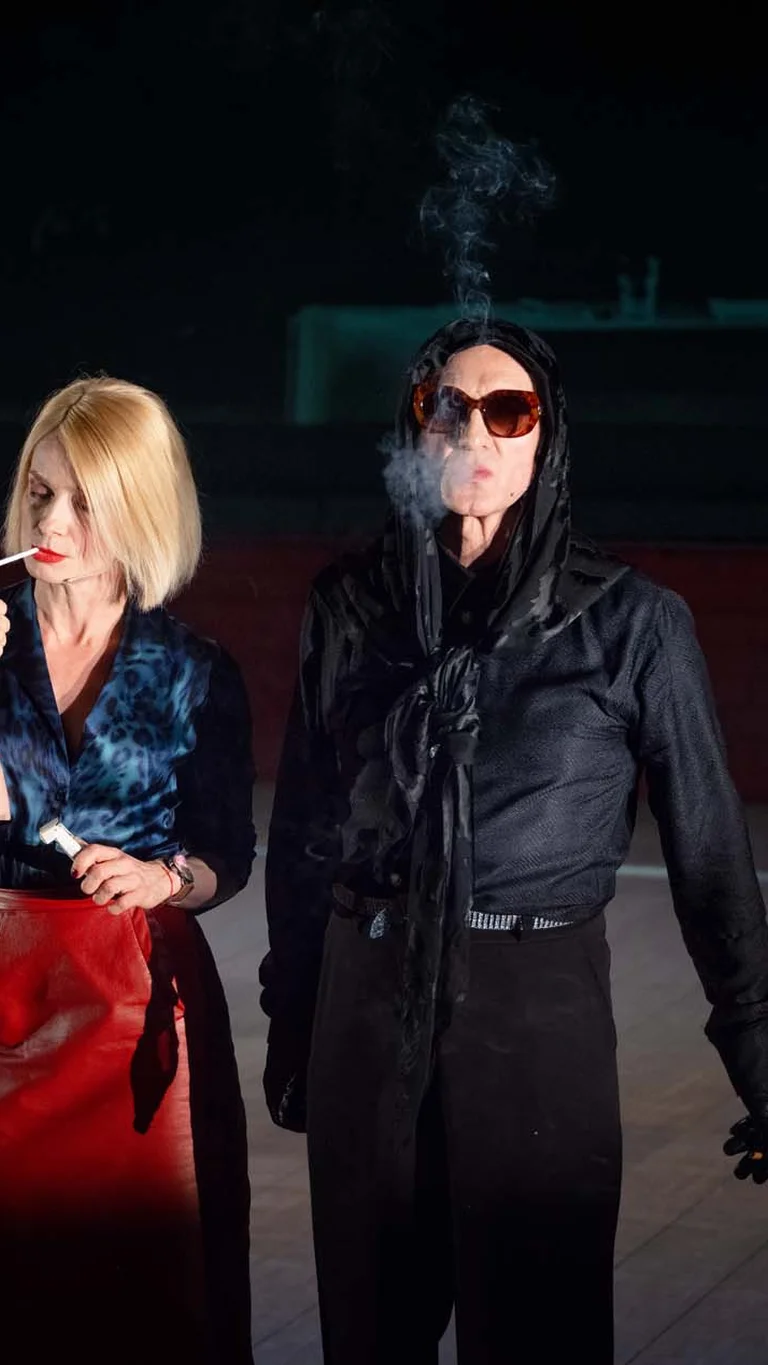
The Greek School of Thought
Piotr Gruszczyński and Anna Lewandowska in conversation with director Krzysztof Warlikowski
Wajdi Mouawad is a writer with whom we have already collaborated on several occasions in the creation of plays, for example in “African Stories based on Shakespeare”, for which he wrote entirely new monologues. Now you have decided to stage his most recent play, which premiered in August 2025. What fascinated you about this text?
Wajdi’s dramaturgical starting point is a massacre that took place 75 years ago. We are less interested in the massacre itself than in its consequences, viewed from the perspective of three successive generations. The question raised by this text is: does the curse – the modern equivalent of which is trauma – passed down from generation to generation ever truly end, or does this chain, once set in motion, continue forever? What could break the curse, neutralise it?
In your theatre, the question of guilt is a very fundamental one. How do you view the problem of guilt here? Who is guilty, and of what? Are we doomed to be guilty?
That is difficult to answer; the question oscillates between ancient tragedy, which was an absolute form and experience, and the present day, in which everything is relativised. Wajdi’s text is deeply rooted in Greek tragedy and yet is set in the present day. In my theatre, there are indeed a great many plays in which we discuss guilt. It can open up a dialogue. Kafka created and presented the figure of the guilty party, and I myself tend to side with those who feel guilty rather than with those who repress that guilt. I do think, however, that for Wajdi Mouawad, guilt is not the actual theme. The guilt is obvious here; what is more important is the question: does this guilt also affect the descendants of the murderers? Are we tainted by what, for example, our grandparents did, or do we have the right to say: ‘I’ve got nothing to do with that.’ The Greek curse, fate, made no exceptions. I am reminded of Racine’s Phèdre: ‘The curse extends further…’. Massacres and genocide have the effect of such a curse. We live in the shadow of past violence, even if we are not aware of it. Ignorance is of no help whatsoever here – the curse is always at work, and is even more potent for those who are unaware.
„The connection to Greek tragedy is significant to me, as it is also my sphere of thought, the field of my ethical and philosophical explorations.“
And do you believe in the curse?
A curse can be described with different words. Today, it is a trauma passed down from generation to generation. But is that a curse in the Greek sense? Wajdi poses a crucial question: how can a tragedy be brought to an end? Even the Greek tragedians could find no human answer to this and resorted to the deus ex machina. A sudden, external force that appears and imposes a solution which may not be entirely convincing, but which allows the world to carry on.
In your theatre, you very often draw on situations that are impossible in the human world, and you like to incorporate them into your productions. In Europa, there are many such situations. Wajdi Mouawad’s play is strongly influenced by Greek tragedy. What makes this form so relevant to you even today?
Wajdi Mouawad grew up with Greek theatre. This is not entirely unrelated to his Lebanese origins, as Lebanon was an important setting for mythological events. It was here that the abduction of Europa took place. The connection to Greek tragedy is significant to me, as it is also my sphere of thought, the field of my ethical and philosophical explorations. In his text, Wajdi undoubtedly engages with the tragedians of antiquity, but also with the question of what constitutes a tragedy today and whether tragedy is even possible. With the end of antiquity, tragedy itself underwent a fundamental transformation. Wajdi’s text therefore not only examines the tragedians but also asks what tragedy means today and whether it is even still possible.
The question is whether today’s world, with its everyday reality, can be analysed using tragic categories, or whether these criteria are set too high?
Every time I pick up a Greek tragedy, I do so in the hope that it will describe today’s world, even though we all know, of course, that it will not. If only because it has no access to the characters’ thoughts. And yet we keep returning to these texts. Most likely because the Greek tragedians offer us a far more comprehensive perspective than the dramatic narratives of the 20th century and the present day, which focus on characters and are pragmatically conceived for the theatre. Greek tragedy embodies a sense of necessity; with a contemporary text, the director is always faced with the question of what is necessary, and whether a particular scene is necessary. When one engages with a Greek text, one gets the impression that even if a scene is rewritten or reimagined, it nevertheless remains absolutely indispensable to the structure of the play. That is precisely this sense of necessity.
„We will not set the world right with a cry of protest or any violent gesture. We can only do so through conversation and reflection.“
And do you personally feel the need for a happy ending? The world is oppressive; the audience are despondent and frightened; I don’t know whether they’re still ready for bleak theatrical experiences that offer no opportunity for a celebration of life?
My language used to be more uncompromising; it demanded truth at any cost. When you’re young, you harbour the illusion that you can change the world, so we fight for a better world. The theatre is one of the last places where we can at least try to do so. But we will not set the world right with a cry of protest or any violent gesture. We can only do so through conversation and reflection. That is why I now think differently about the ending of a theatre performance, whatever it may be – it is a very difficult decision for the director. I try to end in such a way that we can enter into conversation. So that a community is formed that is open to further dialogue.
And is that what storytelling in theatre is for? What Wajdi refers to by the French term ‘le récit’, which also has its roots in tragedy. Can that be effective?
Wajdi’s tragedy does not merely break with temporal linearity. It is difficult to put the sequence of its events in order. What happened first? What befell whom first; at what point do the heroines discover the next revelations; do they recognise their fate? This realisation is an indispensable part of the tragic structure, the climax towards which the narrative is heading. Yet Wajdi scatters the crucial points throughout the entire text. He conceals them and forces the audience to piece this puzzle together themselves. This can be compared to Agatha Christie’s method, albeit applied in a completely different genre.
The female characters in Europa are people of the present day; they make no excessive demands on life and suddenly find themselves exposed to a tragic relentlessness whose laws leave no room for negotiation. Do you think one can negotiate with fate – or is fate merely an excuse for our misguided decisions?
Seeking to negotiate with fate is part of the tragedy. I am reminded of Oedipus, who does everything in his power to prevent the oracle’s words from coming true. The tension between Greek necessity and human ‘tinkering’ turns us into tragic heroes and places us at the heart of the tragedy. Here, the trauma is passed on, though not consciously, not for instance through stories or other traditions, but in a hidden way: it is encoded in our genes. And that is not something that can be negotiated. This is illustrated by Zacharias, a third-generation descendant who himself becomes a murderer.
This is linked to a taboo: something becomes a secret because we do not want to have access to it. In Wajdi’s tragedy, the second generation – our protagonists – already have no chance of ever learning the truth. Life hurls them far away from the site of the massacre. Each of them has grown up somewhere else entirely, outside the community that upholds the taboo and whose secrets are guarded. This offers an opportunity, but also harbours a danger, for the inherited trauma becomes a fate; unconsciously and unspoken, it destroys our lives. Anyone who remains in a place marked by blood is marked by guilt, even though they are objectively innocent. Distance therefore also creates safety and an opportunity.
Who is Europa in Wajdi’s text?
It is ironic that Wajdi names his main character Europa. At first glance, this name seems entirely innocent – one of those mythological names the Greeks loved and which are being used again today. Yet this name embodies everything associated with our continent, starting with darkness. After all, unlike Asia, Europe was the place where the sun set. A place where so much has happened and where, to this day, we struggle with our European identity?
The performance space spans the spectrum between a classroom and a courtroom. These are public spaces in which you are staging an intimate, almost psychotherapeutic play. How do you view this spatial compression?
Everything we learn in a classroom is meant to prevent us from ending up in court one day. In Wajdi’s work, this court had its origins in a classroom that was the scene of a massacre, had stood abandoned for 75 years, and suddenly became a place of remembrance, a witness that had preserved an encrypted record. One must return there to decipher this record and understand why one of the protagonists stood trial, accused of a brutal murder.