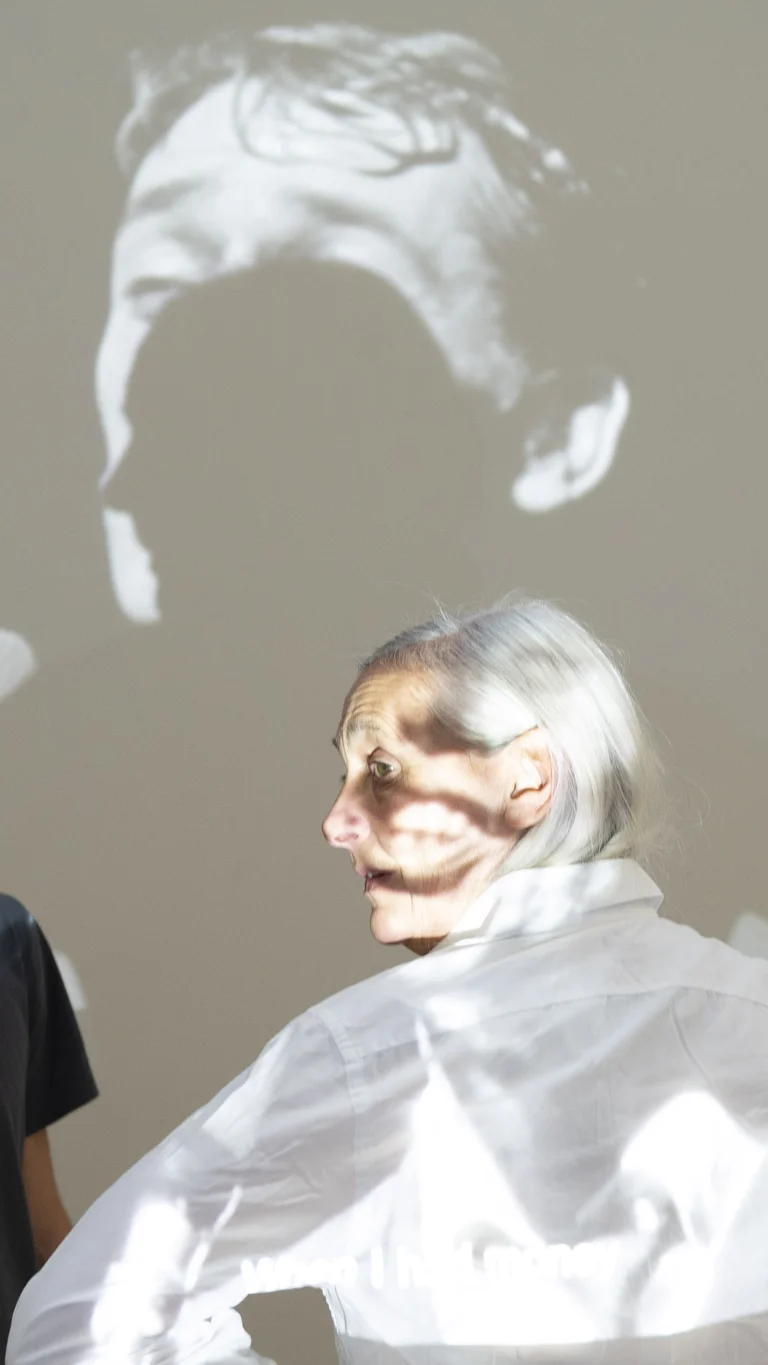
Finding Brel in Motion
Marc Blanchet in conversation with Anne Teresa De Keersmaeker and Solal Mariotte
Marc Blanchet: How did the idea of a show based on Jacques Brel’s songs come about?
Anne Teresa De Keersmaeker: Before we even started working on the group show EXIT ABOVE, which we presented at the Festival d’Avignon in 2023 and in which Solal dances, we had the opportunity to talk about our shared fascination for Jacques Brel, both as a singer and a writer, and notably for his extraordinary stage presence. We both admire his energy, even though we’re two generations apart. Likewise, Solal is French while I am Flemish Belgian. Jacques Brel has always been part of my personal history. He played a role in my education as well as in my learning of the French language. I would go as far as to say that he is part of the world’s cultural heritage. When I was 15, I had to do a close reading of a song for my French class. I chose Le Plat pays, moved by both the music and the lyrics, by the poetry with which Jacques Brel ‘reads’ the Flemish landscape. I also remember the controversies surrounding his song Les Flamingants, (...), in which he denounced the defense of Flemish culture at the time.
Solal Mariotte: As for me, I discovered him in my teenage years, less than a decade ago, through YouTube videos. What appealed to me, beyond the quality of the songs, was the frenetic way he had of performing, of always giving one hundred percent. Before joining P.A.R.T.S., Anne Teresa’s school, I knew a little about Belgium, though I’d never been there. I think listening to Jacques Brel here in Brussels made him all the more intriguing. He moves me, even though he speaks of a bygone era, often using old-fashioned expressions, something which to me feels almost kitsch. I can appreciate his songs without having to relate personally to many of them. Some are timeless, but others seem to me completely outdated!
„Jacques Brel has always been part of my personal history [...] I would go as far as to say that he is part of the world’s cultural heritage.“
MB: Solal, you come from breakdancing. Your dance, with its rhythms and syncopations, seems far removed from the world of Jacques Brel. Which doesn’t seem to be the case for you, Anne Teresa …
SM: Obviously, when it comes to my relationship with dance, Jacques Brel’s songs don’t make me – or people in general – want to dance! My formative years took place far from this type of music. And to be honest, Brel’s songs are so rich that one could wonder if there was any need to add dancing to them. But if I close my eyes while listening to his songs, images come to mind, a world unfolds. My connection to Jacques Brel also comes through an exploration of the intersections between dance and text. As a student at P.A.R.T.S., I had to present a first project to all other students: a solo piece. I chose La Valse à mille temps. At the time, I had no plans for a duo with Anne Teresa. I did it spontaneously, working on the song’s crescendo, without using any breakdancing move! I’d go so far as to say that the dance itself was minimal. (...) I was most interested in exploring the ideas of acceleration, spinning, frenzy – and, above all, the potential within the poetic imagery of the song.
ATDK: In terms of both music and imagery, my experience is different because, in 2001, I created the choreography Once, based on Joan Baez’s album In Concert, Part 2. Her music had been a part of my life since childhood. I explored different strategies in the relationship between music and dance. Similarly, my connection to text isn’t new. I’ve worked with poetic texts, including poems by Rainer Maria Rilke or, in a more underlying way, Shakespeare. I’ve also used opera libretti. As for our respective experience with dance, Solal is an autodidact, whereas I had to face the impossibility of pursuing classical ballet before becoming a contemporary dancer and choreographer …
„The challenge for us was to create a collaboration between all three of us [...] in order to find balance within a contemporary approach.“
MB: The idea, for you, is to ‘dance Jacques Brel’, both his songs and his personality?
SM: My commitment to this show, inspired by Jacques Brel’s powerful stage presence, is to fully throw myself at the performative aspect. Anne Teresa and I have found common ground to approach a ‘personal’ Brel. Without copying or mimicking each other, we were driven by the desire to achieve a quality of dance that would feel at once personal and shared. Breakdancers see me as a contemporary dancer, while contemporary dancers see me as a breakdancer! But in Anne Teresa’s dance, in what she’s been developing for years as a choreographer, there are elements that resonate strongly with breakdancing. Some of the vertical concepts she uses can absolutely exist within the horizontality of my dance.
ATDK: Our goal was to find this intersection. It’s not about ‘appropriating’ Jacques Brel, but rather to ask, in English, how to embody it, that is, how to channel this energy. But we also paid close attention to his perspective on the world, social justice, love, relationships, women, old age, childhood, family, friendship, and complicity, on the things he disliked, like the violence he often sang about. His songs explore themes of identity, of one’s relationship to one’s country, but also of the father-son relationship and of tradition. We made sure to engage with those themes while also maintaining a necessary distance, to see how, without shying away from controversy, his songs can still raise meaningful questions.
MB: French spectators will immediately understand the words of Jacques Brel’s songs. Mental images come right away …
ATDK: In that sense, our choreography is a real challenge! With songs in English, some might understand the words completely, others only intermittently … and others yet not at all. Our goal is to avoid being merely illustrative. Yet we also need to remain aware that Jacques Brel’s music, no matter how energetic it is, orchestrated or not, has little to do with the beat of breakdancing. Regardless of the arrangements, his songs exist somewhere between bal musette, waltz, and the legacy of Debussy and Ravel – even though he himself was more of an admirer of Bach and Beethoven.
SM: Even though Jacques Brel is known primarily for the depth of his lyrics, and although we wanted to avoid being purely illustrative, we must not forget that Brel offers a deep reflection about what it means to be human and about the world we live in. The challenge for us was to create a collaboration between all three of us – Brel, De Keersmaeker, and me – in order to find balance within a contemporary approach.
ATDK: I’m starting to collect experience with music that, at first glance, doesn’t seem suitable for dancing. I like the idea of making that kind of music move through the body, rather than seeing it as something sacred. Our choreographic approach was also enriched by the amazing number of documents made available through the Fondation Jacques Brel, thanks to his daughter France. It’s rare to have access to such a rich musical heritage from that period, with so many first-hand accounts. And it’s fascinating to see him in those films, either from up close or separated from the orchestra by a curtain, in the spotlight of a follow spot (...)
The interview was conducted by Marc Blanchet in January 2025 for the 79th Festival d’Avignon © Festival d’Avignon