“We can create ourselves”
Ivo Van Hove on David Bowie and his other idols, encounters with the singer in New York, Bowie’s “power of authority” and the transcendent power of love.
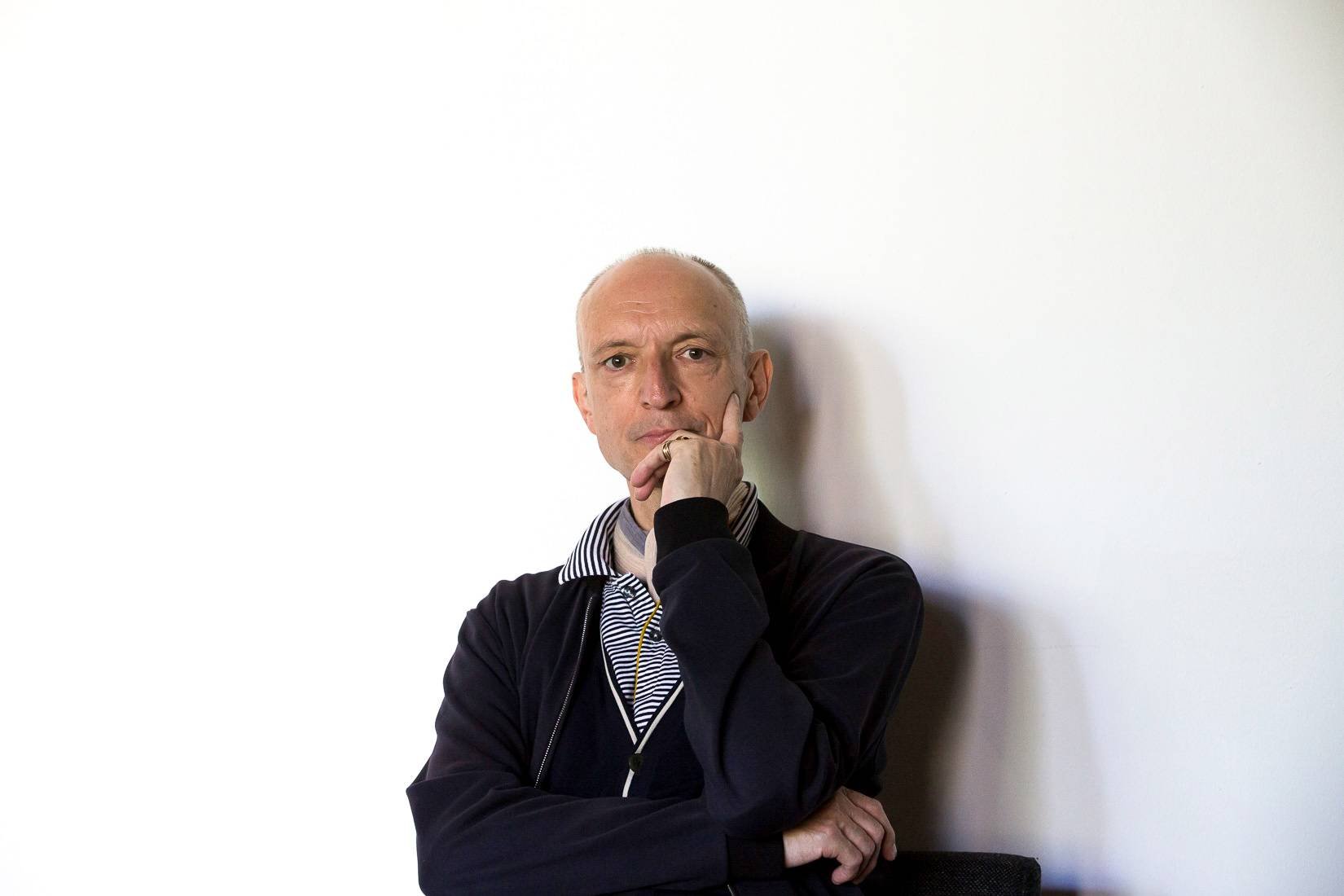
Contemporaneity is a powerful concept: it embodies cosmopolitanism, a sense of immediacy and vitality, as well as the idea of brotherhood. It denotes an interest in the present, which cannot, however, be productive without an appreciation of tradition. Ivo Van Hove, based in Belgium and the Netherlands but artistically just as much at home in Amsterdam and Antwerp as in Paris, Madrid, London and New York, is a cosmopolitan of the arts who has directed works by Euripides and Sophocles, Shakespeare and Marlowe, Arthur Miller, John Cassavetes, Ingmar Bergman and many others. “Longing for tomorrow”, the motto of his three-year Ruhrtriennale, expresses a sense of identity that views the past, present and future through a single lens.
Incidentally, his career started outside of established theatre venues. In 1980, at the age of 21, he used a bare hall in the Port of Antwerp, as big as the Jahrhunderthalle, for his first production. “That’s where we discovered our style, inspired by performance art, as well as by Peter Stein and his Oresteia in Berlin, and by Peter Zadek – “wow! His Lulu was incredible, raw and imperfect.”
Echoes resonating to this day
Does the artistic director still feel a sense of longing when anticipating the future? Van Hove: “More than ever. Four years ago, at the start of Russia’s war against Ukraine, I already realised how violence was becoming established as a legitimate means of achieving political goals. This reality has also grown since then, bringing with it the danger of acceptance - something we need to resist. And I see that artists are reacting to this artistically – not directly as political theatre, but rather in the sense that politics concerns the polis, the community.”
Looking back at previous festival seasons, productions such as Kirill Serebrennikov’s LEGENDE, Łukasz Twarkowski’s Oracle and FC Bergman’s Guernica Guernica moved along the timeline, bringing historical figures, motifs, themes and events into the present in order to point towards the future. Looking ahead to the current season, this perspective is also relevant: for example, for Deutscher Herbst (German Autumn), which opens up an echo chamber stretching from the post-war year 1946, through 1977, up to the present day, and reflects on changing mentalities and turning points. And it also applies to Europa as a tragedy and a trauma narrative that continues to play out across generations. The festival’s repeated invitation of projects from Eastern Europe – such as this summer’s production by Krzysztof Warlikowski from Poland with the Novy Teatr Warszawa – underscores the urgent need for the integration of the continent.
Ivo Van Hove emphasises this further: “It’s a new old dimension; only we’d almost forgotten about it. In the same way, we must now take care not to forget Ukraine again and allow it to be pushed out of the headlines by more recent flashpoints – which is also a problem of media attention and, more generally, human nature. Similar to the Vietnam War – I am a child of that era, having grown up in the 1960s – back then there was this phenomenon of things disappearing from public view. I’m in New York right now, where people are worried that Iran could escalate into a second Iraq War – or a second Vietnam.”
New York is the city where Van Hove first staged David Bowie’s musical Lazarus ten years ago: the premiere was in December 2015. He was the only member of the team who knew how ill Bowie was. When he felt well, Bowie would often come to rehearsals. They had both worked intensively on the project for quite some time prior to that, though Bowie had never exercised his “power of authority”. He considered critical comments and dramaturgical questions, then discussed and ultimately accepted them. ‘“His dream was to write music for the theatre,”’ he confided to him.
Fassbinder, Chéreau and Bowie
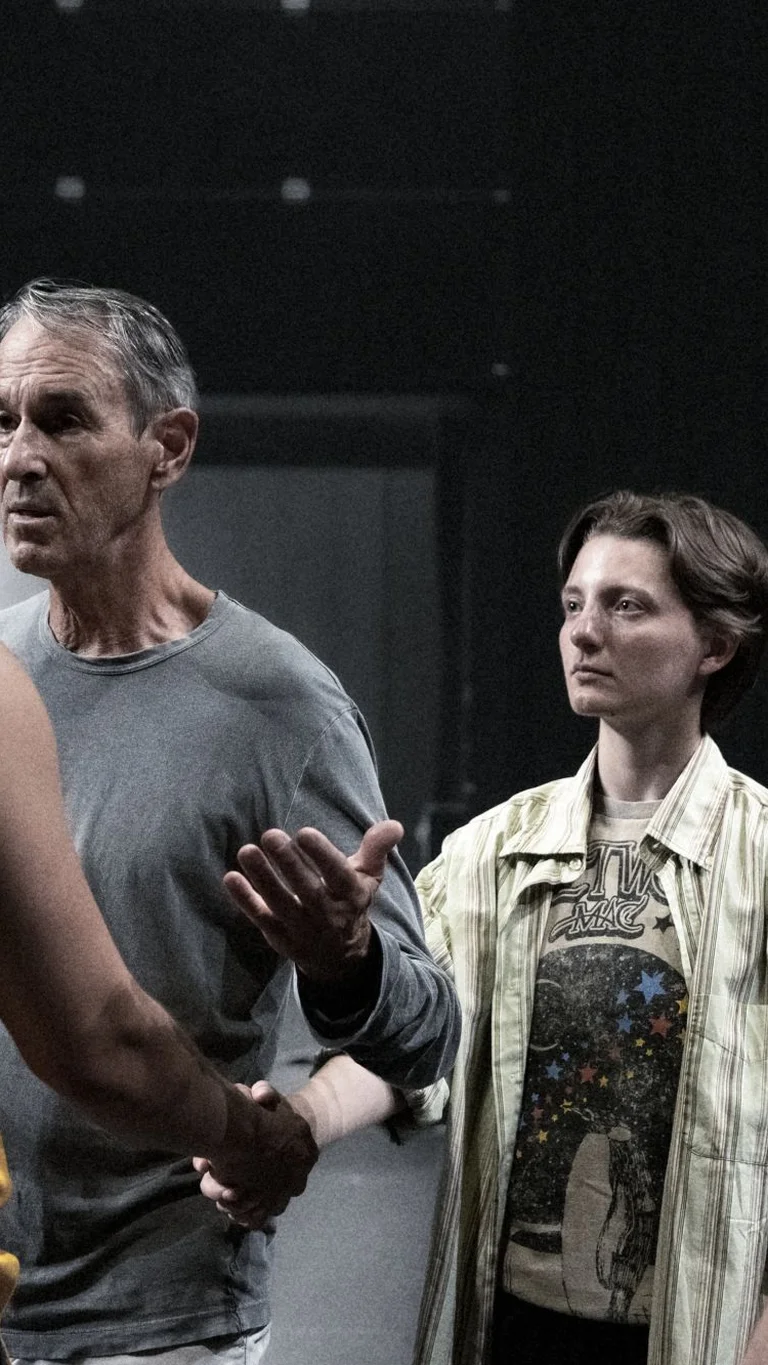
Was it clear to Ivo Van Hove from the very beginning that he would stage three musical openings? “Yes, that was the plan, but it wasn’t clear which ones exactly. P.J. Harvey with Sandra Hüller was settled. Frank Sinatra / Nina Simone wasn’t. Watertown was a chance discovery for me – this beautiful, relatively unknown Sinatra concept album, which he considered his most intimate. While thinking about it, I then came up with the idea of combining it with Nina Simone. And now Rebel Rebel with Bowie – the idea has been around for a long time and has nothing to do with the tenth anniversary of his death.”
He says he shares “the strongest, most personal bond” with him. I had three idols: Rainer Werner Fassbinder – I literally waited for every single one of his films in the 1970s. His death was a shock for me. Then Patrice Chéreau – I often travelled to Paris to see his productions, even though I had very little money, and had to go straight back afterwards. And Bowie.”
Van Hove has selected 35 songs from a wide range of albums, starting with the first one from the Sixties (“a revelation for me”), some of which are lesser-known and others very famous. He says that every song is relevant to the story and its purpose. In the song Rebel Rebel, one line reads: “You’ve got your mother in a whirl / She’s not sure if you’re a boy or a girl”. This encapsulates the ambiguity and chameleon-like quality that Bowie embodied, from Ziggy Stardust to the Thin White Duke and Berlin’s Prince of the Night, right through to the ultimate pop icon. From outsider to centre stage. He took the liberty, as Thomas Mann put it, of “living in metaphor”. Identity in role-play.
“Love conquers all”
Is it this shifting, ambivalent nature that Van Hove finds so fascinating about Bowie? “Yes, of course, one of his best-known songs is called Changes. In Bowie’s view, we don’t have to be what we are. We can create ourselves. Can decide for ourselves.”
Bowie thought of “life as a possible journey” – from one stop to the next, without knowing when the final destination will be reached. “This perspective is important for our production. It begins at a dystopian point, loosely based on Orwell’s 1984. Set in a town where everything is forbidden: love, friendship, human contact, and which is terrorised by an aggressive gang. Many of Bowie’s songs are about how individuals have no place in a socially brutal environment and have to fight to make a place for themselves. There is a pessimistic young man and a rather optimistic young woman, who could also be a man – that remains unclear. For me, the finale culminates in the famous phrase from the Latin: Amor vincit omnia. Love conquers all.”
It is somewhat reminiscent of an exaggerated version of West Side Story, the musical by Leonard Bernstein and Stephen Sondheim, which you have also directed? “That’s right, that’s my thing”. The self-empowerment of the other, the outsider, the ‘impure’: Van Hove finds this in Fassbinder and Chéreau, as well as in Tennessee Williams, Pasolini, Visconti and Tony Kushner, whose plays and works have constantly intrigued him.
In the video for the song Lazarus, Bowie floats up from his deathbed, hallucinating his younger self as if in a time warp, and transcends his own death. It’s not all over yet. Is that how Van Hove experienced him? He hesitates, he says it is very “difficult” for him to talk about it. He had encouraged David Bowie to place the Lazarus song in the musical so that the character’s fundamental problem would be understood: dying. “Look up here, I’m in heaven” is the first line. In retrospect, it’s like a final artistic statement. Even today, he says it is emotionally impossible for him to listen to the album Blackstar. “And I had to switch off the Lazarus video after 15 seconds. It was too much for me. Unbelievable how someone managed to transform their own death into art.”
This article was published in the Ruhrtriennale Special edition of kultur.west.
About the author
Andreas Wilink wurde 1957 in Bocholt geboren, studierte Germanistik, Geschichte und Kunstgeschichte an der Heinrich-Heine-Universität Düsseldorf. Der auch in Düsseldorf lebende Kulturjournalist, Theater- und Filmkritiker war seit den 80er Jahren Redakteur der Westdeutschen Zeitung, wechselte dann zur Süddeutschen Zeitung, bevor er 2003 das NRW-Magazin kultur.west mitbegründet und bis 2018 geleitet hat. Als Autor schrieb bzw. schreibt er unter anderem für den WDR und Deutschlandfunk, Theater heute und nachtkritik. Für die Berliner Festspiele hat er als Juror sechs Jahre lang die Auswahl des Berliner Theatertreffens mitbestimmt.