“How do you end a tragedy?”
The aftermath of a massacre: Krzysztof Warlikowski stages Europa (based on Wajdi Mouawad’s play Europa's Pledge) at Jahrhunderthalle in Bochum.
Małgorzata Szczęśniak’s stage, which is just as reminiscent of a classroom as it is of a (gym) hall or an internment camp, is still deserted. Only the large board in the background shows the close-up of a young girl as a video projection. At least, that’s what the mask with its wide-open eyes suggests, behind which the actor and former gymnast Claude Bardouil is concealed. There is something ghostly about the mask’s frozen features, with its enormous pupils. The dark video images of this ageless face are unsettling. A deep horror is etched into the features. Yet it remains unclear whether this girl is frozen with fear or is playing a particularly malicious game with her soft toys.
While the audience watches the video, as if hypnotised, an elderly woman, played by Andrzej Chyra, hesitantly enters the stage from the right. She is wearing a brown fur coat, large brown sunglasses and a black headscarf. Although her features are not concealed by a mask, her whole appearance resembles a masquerade. This woman named Europa seems to be hiding behind her elegance. After a brief glance at the video, she looks away and steadies herself against one of the school desks lined up on the stage.
At this point in Krzysztof Warlikowski’s adaptation of Wajdi Mouawad’s play Europa's Pleadge, everything is still open. Yet, indications of entanglements and connections are already emerging. As viewers watch the older woman and the girl, the suspicion takes hold that these two figures might actually be one and the same person. In these opening moments, Warlikowski weaves a web of glances, allusions and moods that is so subtle and intricate one is immediately drawn into Mouawad’s tragedy.
Hardly any contemporary playwright grapples with the political and personal upheavals rooted in the genocides, civil wars, massacres and movements of refugees of the past 80 years quite like Wajdi Mouawad. In Verbrennungen, the play which marked the Lebanese-Canadian writer and playwright’s breakthrough on German-speaking stages, fictionalised events from the Lebanese Civil War, which drove his family into exile first in France and then in Canada, are interwoven with references to Sophocles’ Oedipus. In this way, Mouawad expands his focus from specific atrocities to fundamental structural patterns.
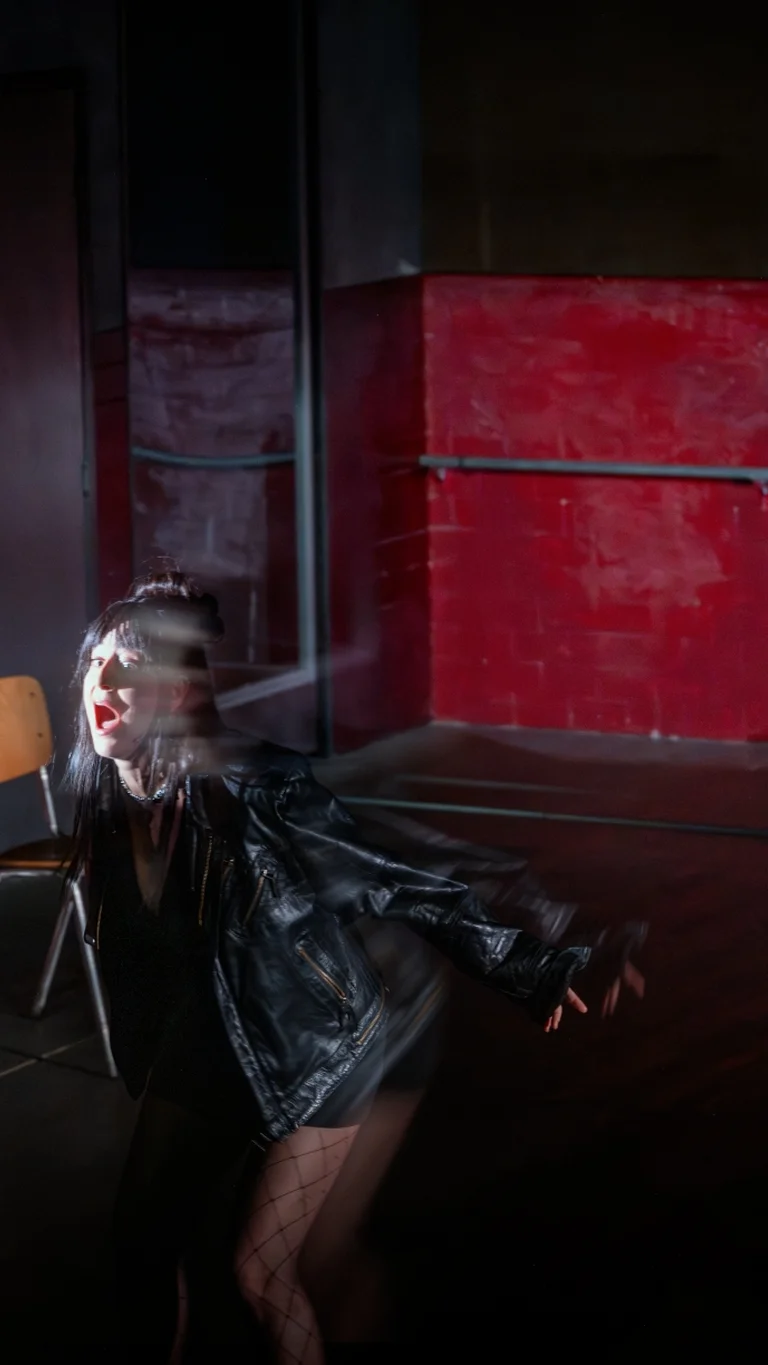
The massacre that Europa revolves around took place in 1952 in the fictional region of Hafeztan. Europa, who was eight years old at the time, not only witnessed relatives of hers abusing and murdering women, men and children. She herself also became complicit in the violence. Seventy-five years later, she is confronted by Assia, a UN investigator and descendant of the massacre’s victims. And thus, a hidden family history comes to light. Krzysztof Warlikowski further reflects on Mouawad’s question of how violence and trauma are inscribed in people’s lives across generations. In his production, the eight-year-old Europa is quite literally a constant companion of her later self. Her movements, which are sometimes violent and seem to be shaken by convulsions, not only reflect the inner life of eighty-three-year-old Europa, which is filled with hatred and self-loathing. They also reveal the turmoil and restlessness of Europa’s daughters and her grandson. Ultimately, this leaves us all with a question posed by Mouawad, but which neither he nor Warlikowski answer: “How do you end a tragedy?”
This article was published in the Ruhrtriennale Special edition of kultur.west.
About the author
Sascha Westphal ist seit 2011 als Autor für kultur.west tätig und gehört seit 2018 der Redaktion an. Geboren 1971 in Dortmund, wo er auch aufgewachsen ist, hat er in Bochum Theater-, Film- und Fernsehwissenschaften, Germanistik und Geschichte studiert. Als Autor schreibt er vor allem über Schauspielinszenierungen, Filme und gelegentlich auch über Literatur. Seit 2021 ist er Mitglied der Auswahljury des Berliner Theatertreffens.